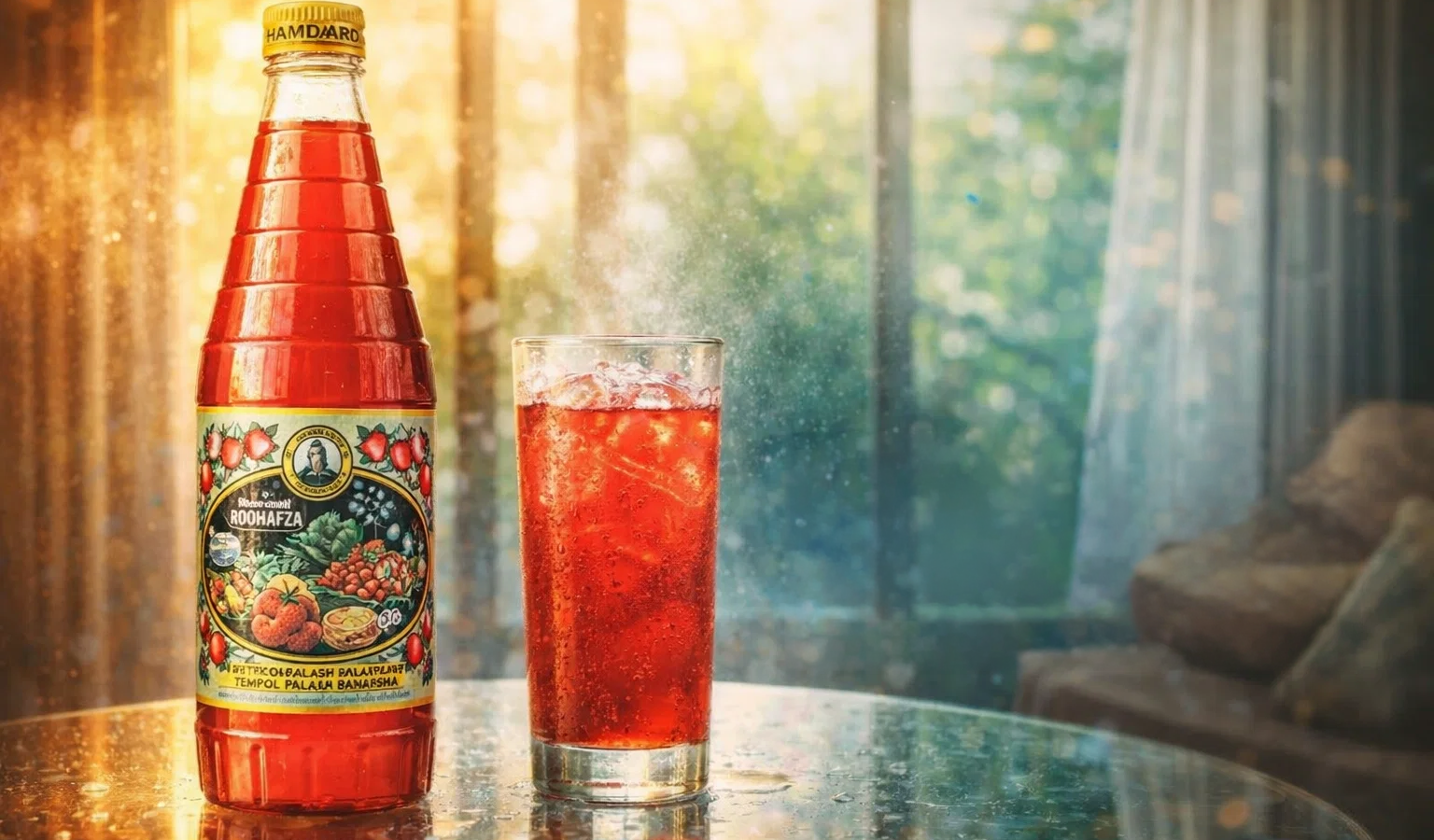
In 1907, a hakim in Delhi named Abdul Majeed Hamdard created a concentrated sherbet syrup. He bottled it in a tall, slender glass bottle and labelled it in Urdu and Persian script. He called it Rooh Afza, “that which refreshes the soul.”
One hundred and eighteen years later, the bottle looks almost identical.
The glass has been replaced with PET plastic in some formats. The label has been refined, better printing, slightly cleaner layout. But the fundamental design DNA is unchanged: elongated silhouette, red label, Arabic/Urdu script, the characteristic illustration of a garden scene. You could show a 1970 bottle next to a 2024 bottle and the lineage is unmistakable.
For most brands, this would be called outdated. For Rooh Afza, it’s the product.
The bottle’s design carries a specific cultural and religious weight that is inseparable from the product’s identity. Rooh Afza is deeply embedded in Ramadan i.e. it’s the sherbet of Iftar. It’s in Indian Muslim households as a ritual object, not just a beverage. The bottle’s traditional aesthetic reinforces that ritual status. A modernised, minimalist Rooh Afza bottle would feel like a violation, like redesigning a religious artefact.
Hamdard understood something most FMCG brands don’t: when a product becomes a cultural ritual object, the packaging is not just a container. It’s part of the ritual. You redesign it at your own peril.
Takeaway
When a product is embedded in cultural or religious ritual, its packaging carries symbolic weight beyond pure communication. Before redesigning a heritage brand, ask: is the old design a bug or a feature?