India’s skincare market in 2020 had a language problem.
“Brightening.” “Hydrating.” “Nourishing.” Every premium brand said some version of the same vague claim. The price tag was the only differentiator, because the claims were identical and entirely unverifiable.
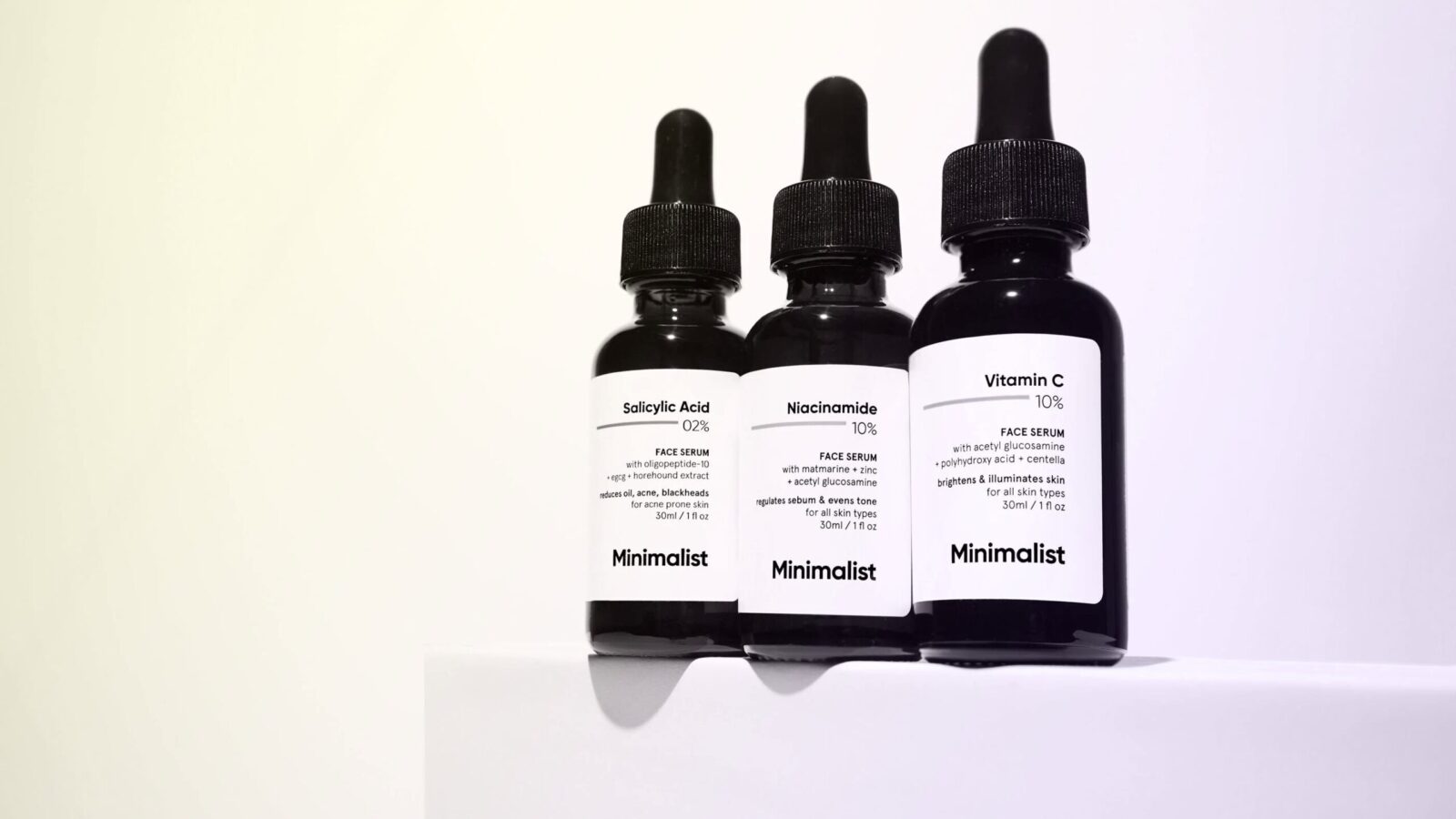
Rahul Yadav and Alok Patwa launched Minimalist in 2020 with one rule: every product lists the concentration of the active ingredient on the front label. Not in fine print. On the front. 10% Niacinamide. 0.3% Retinol. 25% Vitamin C.
For a consumer who had started Googling skincare ingredients, this was a revelation. For a consumer who had been paying ₹2,000 for a “vitamin C serum” without knowing what percentage of vitamin C was in it, it was an exposure.
Minimalist priced between ₹500 and ₹1,200 per product. Kiehl’s and The Body Shop were selling comparable actives at three to five times the price with far less transparency. The brand did not compete on aesthetics or heritage. It competed on being the first to tell consumers what they were actually buying.
Revenue moved from ₹184 crore (FY23) to ₹347 crore (FY24) to ₹514 crore (FY25). Profits doubled. By March 2025, HUL bought 90.5% for ₹2,955 crore, making it the largest acquisition in Indian D2C skincare history.
What HUL bought was not a product line. It bought the positioning that the next generation of Indian skincare consumers already trusts, and the founding team that knows how to maintain it without destroying it through corporate integration.
As we examined in the story of how mCaffeine made skincare feel credible by borrowing identity from coffee culture, [the brand that educates earns loyalty that paid advertising cannot replicate. Minimalist made the percentage the education.
The acquisition follows the same template ITC used with Yoga Bar: a conglomerate pays for the brand equity and the customer base, then uses its distribution muscle to scale what the startup proved could work.
And what made the Minimalist exit possible was what Nykaa demonstrated years earlier: content and credibility built before commerce creates a customer who does not leave when a cheaper alternative appears.
The label was the ad. The percentage was the price justification. The exit was the validation.
Want your brand to stand out like this? Get a quick audit done by our experts.