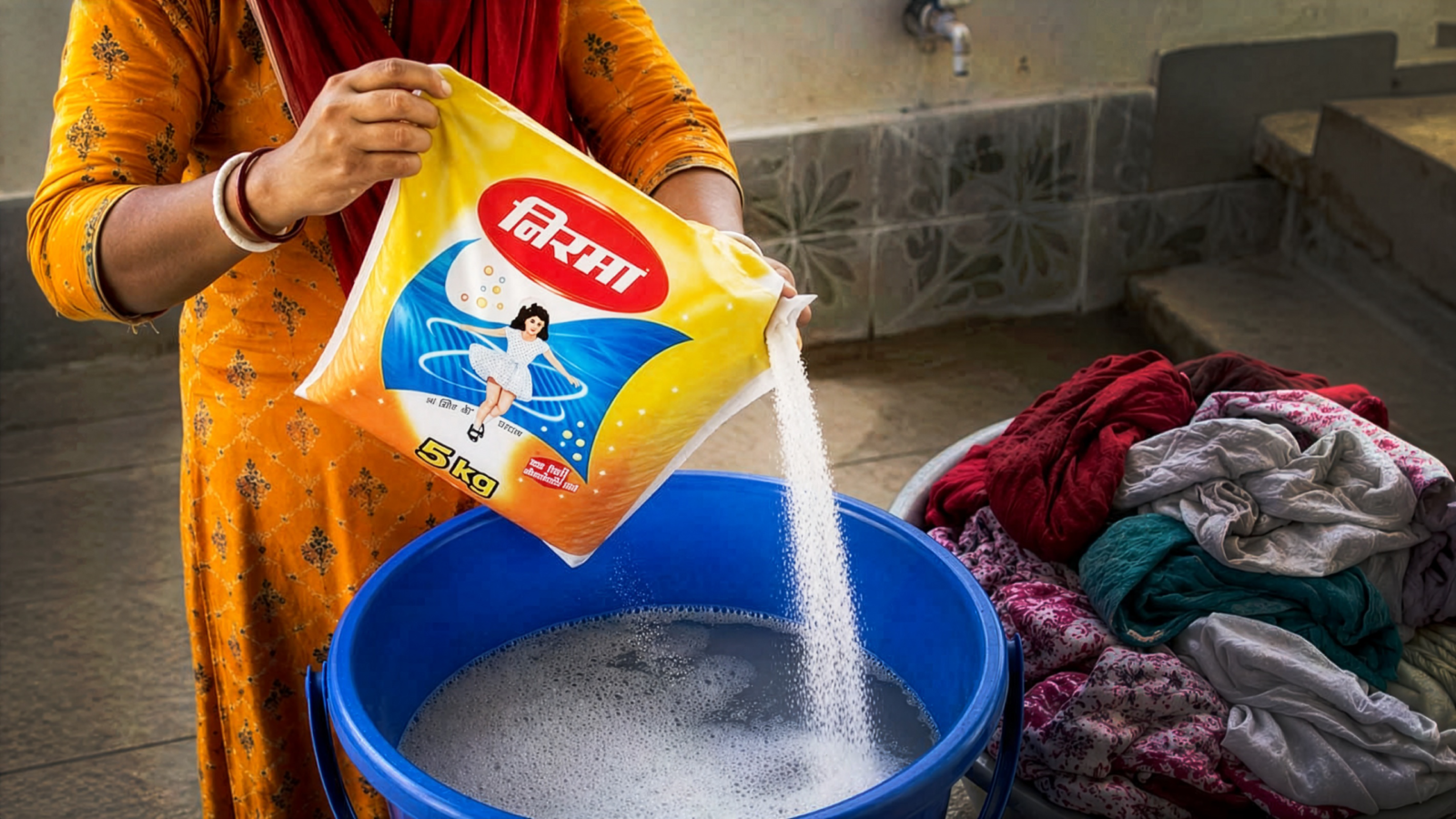
Karsanbhai Patel was a chemist at a government lab in Gujarat when he started mixing detergent powder in the courtyard of his house in Ahmedabad in 1969.
He sold it himself, door to door, on a bicycle, after his day job. There was no ad agency and no market research. There was a price: Nirma cost less than half of what Hindustan Lever’s Surf was charging at the time.
Hindustan Lever had run India’s branded detergent market for close to three decades with almost no serious domestic challenger. Nirma didn’t try to out-market Surf. It simply asked a question nobody at Lever had bothered to ask: what happens if you make a detergent good enough for a household that was washing clothes with soap bars and ash because branded powder was too expensive?
By the early 1990s, Nirma was the largest selling detergent brand in India by volume, ahead of every product in Hindustan Lever’s portfolio. The multinational’s response came years later, in the shape of a new value brand of its own called Wheel, built specifically to fight Nirma on price.
The jingle helped. “Washing powder Nirma” and its dancing girl in a white frock ran on Doordarshan for years and became one of the most recognised four seconds of sound in Indian advertising, entirely disproportionate to what the company spent on media.
Ghadi Detergent ran almost the same playbook against Surf Excel decades later: undercut on price, skip the celebrity, win the counter first and let the product’s familiarity do the rest. CavinKare’s 50-paise sachet did it to shampoo. And Lahori Zeera proved the same regional-first instinct still works in soft drinks today.
Nirma’s real innovation was never the formula. It was refusing to accept that a multinational’s price point was the only price point a category could have.