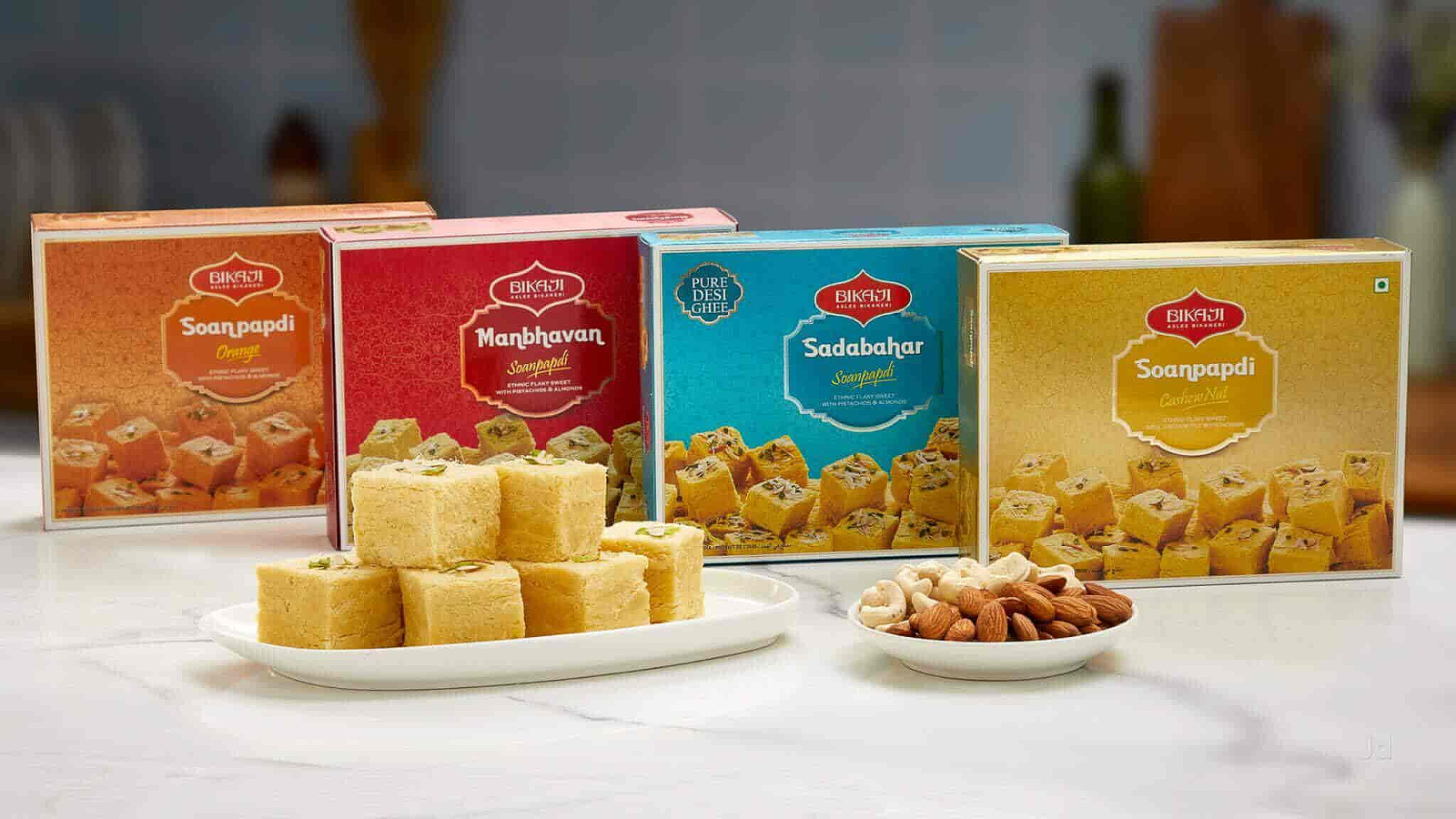
Shivratan Agarwal grew up around the Haldiram family’s namkeen business in Bikaner. In 1987, he started his own venture, registered as Shivdeep Industries, making bhujia and namkeen under a new name: Bikaji.
For most of its life, Bikaji was a regional snack maker competing with dozens of Rajasthani sweet and namkeen shops. It scaled the unglamorous way: building its own manufacturing capacity, becoming India’s largest producer of Bikaneri bhujia at close to 29,380 tonnes a year, and slowly turning a shop’s recipe into a factory’s output.
In November 2022, Bikaji went public. The IPO was priced at ₹300 a share, raised close to ₹881 crore, and was subscribed more than 26 times over, driven largely by institutional investors betting on India’s packaged ethnic snacks category. The company’s revenue had already crossed ₹1,600 crore in FY22 and has continued to climb since, with its market capitalisation touching roughly ₹15,000 crore in recent trading.
What Bikaji proved is that a bhujia recipe can carry the same institutional credibility as any consumer tech listing, provided the distribution and manufacturing behind it are built with the same discipline. The company didn’t reposition itself as anything other than what it always was: a namkeen brand from Bikaner. It just got much, much bigger at doing it.
Haldiram’s own IPO preparation is the most direct parallel, a family snack business finally explaining itself to public market strangers. Farmley shows the same instinct at work in a newer, unbranded category. And Tata’s purchase of Ching’s Secret is proof that regional Indian food brands, done right, are worth serious institutional money.